


I. A rough price range

Before diving into the details, here is a rough price range for mainstream high-speed doors on the market in 2026 to give you an idea:
PVC soft-curtain high-speed doors: Approximately 5,000 to 15,000 yuan per unit. This is the most widely used type, suitable for internal partitions in workshops and warehouses; it features a simple structure and fast opening/closing speeds.
Rigid aluminum alloy high-speed doors: 15,000 to 30,000 yuan per unit. These offer thermal insulation, wind resistance, and security features, and are typically used for main factory entrances or garage access points.
Spiral/Stacking high-speed doors: 6,000 to over 20,000 yuan, depending on size. Choose this type for extra-large openings or locations requiring high wind resistance.
Small-scale residential/commercial high-speed doors: Calculated by area, these cost roughly 60 to 150 yuan per square meter. Note that these are simple, small-sized models-completely different from industrial-grade doors.
You might think this price range is too broad. True, but high-speed doors are essentially custom-made products; slight differences in size, configuration, or functionality can double the price. The key is understanding exactly where the cost differences lie.
II. Six key factors influencing high-speed door prices
1. Door opening size-the most direct variable
This is the easiest factor to understand: the larger the door, the more material is required, and naturally, the higher the price. Standard sizes range from 1–8 meters in width and 1–5 meters in height. Extra-wide or extra-high doors require reinforced tracks and dual motors, pushing the price into a higher tier. A quick tip: when measuring, don't just measure the clear opening of the doorway. Leave at least 15 cm of installation space on both sides and 30–40 cm at the top for the motor housing. Many people measure incorrectly and end up paying extra to modify the plan later-a very disadvantageous position to be in.
2. Curtain/Slat Material-Accounts for about 30% of the cost
There is a lot to know about the curtain material for PVC high-speed doors. Cheap versions use thin, standard PVC costing a few dozen yuan per square meter; high-quality versions use thickened (0.8–1.2 mm), tear-resistant PVC treated with UV-resistant additives-making them resistant to low temperatures and sun exposure-with a price difference that can be double.
The same applies to the slats of rigid high-speed doors; factors like aluminum alloy thickness and whether a polyurethane insulation layer is included create significant price differences. In coastal areas, corrosion resistance must also be considered, requiring 304 stainless steel-another added expense.
3. Motor-The "Heart" of the High-Speed Door
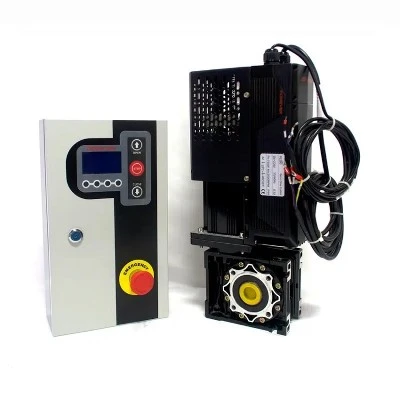
The motor is the most expensive single component of the entire door system and the area most prone to cost-cutting tricks.
Generic fixed-speed motors: Cheap, but cannot handle frequent start-stop cycles; prone to overheating and burnout with continuous use, resulting in a short lifespan.
Domestic variable-frequency motors: The mainstream choice; supports speed adjustment and overload protection-sufficient for daily use.
Imported servo motors: High-end configuration; capable of 24-hour continuous operation with a lifespan exceeding 100,000 cycles, though the price is very high.
For scenarios involving more than 100 opening/closing cycles per day, stick with a servo motor; otherwise, replacing the motor every six months will end up costing you more.
4. Safety Features-An Invisible but Essential Investment
Standard high-speed doors come equipped with four safety features: infrared photoelectric sensors, a bottom safety airbag, automatic reversal upon encountering an obstacle, and a manual release mechanism for power outages. Low-priced products often cut several of these features; some offer nothing more than basic lifting functions.
In factory areas where people and vehicles mix, safety features cannot be compromised. If an accident occurs, the money saved won't be enough to cover the liability costs.
5. Sealing Technology-Directly Affects Performance
The quality of the sealing determines the effectiveness of dustproofing, thermal insulation, and pest prevention. High-quality products feature double-layered sealing brushes on all four sides and a flexible anti-collision rubber strip at the bottom; inferior ones merely have a simple sealing strip applied, leaving gaps wide enough to fit a finger through.
Don't underestimate this detail. For high-speed doors used in cold storage or cleanrooms, poor sealing leads to cold air loss and dust ingress; the resulting costs-higher electricity bills and compromised cleanliness-far exceed the price difference of the door itself.
6. Installation and After-Sales Service: "30% Product, 70% Installation"
This saying is particularly relevant to the high-speed door industry. If the guide rails are installed even a millimeter off-center, operational resistance increases, and the door's lifespan is effectively cut in half. Many door malfunctions stem not from product defects, but from poor installation.
After-sales service is equally critical. Small workshops often vanish after the sale, leaving you to find your own repair technicians if a breakdown occurs. Reliable manufacturers typically offer warranties ranging from one to five years and provide on-site service for local customers within hours. These services come at a cost, which is naturally reflected in the price quote.
III. Five Hidden Traps in Price Quotes-Lessons Learned the Hard Way
Trap 1: Low-price bait followed by add-on costs. You might see an online listing for "High-speed door: 499 RMB/m²," but upon inquiry, you discover the price excludes the motor, installation, and shipping. Once you tally up the extras, the total exceeds the market rate.
Trap 2: Skimping on material thickness. The quote lists "aluminum alloy profiles" without specifying the thickness. In reality, thin materials are used; the guide rails deform after a few months, causing the door to jam.
Trap 3: Substandard motors. They claim to use a "branded motor," but it is actually refurbished or a generic rebadged unit. After six months, noise increases and speed drops; eventually, it stops working altogether.
Trap 4: Bait-and-switch on features. You request variable frequency speed control, but they install a fixed-speed unit, claiming "speed can be adjusted"-when in fact, they've simply changed the gear ratio.
Trap 5: Quote excludes installation. Some small manufacturers quote only the price of the door unit itself; installation costs extra, and you may even have to arrange the installation yourself after delivery. IV. How to Inquire Without Looking Like a Novice
Don't start by asking, "How much for a set of high-speed doors?" Asking this way essentially tells the vendor, "I don't know anything; feel free to rip me off."
Here is the right way to make an inquiry:
Clearly state the usage scenario: Where will it be installed? Inside a workshop, at a warehouse entrance, or in a cold storage passageway? Different scenarios require completely different configurations.
Provide accurate opening dimensions: Width × Height, as well as the installation environment (indoor vs. outdoor, floor flatness, and overhead clearance).
Specify the frequency of use: Roughly how many cycles per day? This directly determines the grade of motor required.
Clarify what the quote includes: Does it cover shipping, installation, and the warranty period? Does it include an on-site measurement?
Request a detailed specification list: The quote should list the curtain material and thickness, motor brand and model, and safety features.
One practical tip: If you are making a bulk purchase or buying for a major project, it is best to visit the manufacturer in person. A company with its own production workshop and installation team is a completely different proposition from one that merely has a storefront to take orders and then subcontracts the work.
V. A Final Word of Advice
With high-speed doors, you really get what you pay for. If a product on the market is priced more than 30% below the norm, you can be certain that costs were cut in areas you can't see. Saving a few thousand upfront often leads to far higher costs later due to repairs, replacements, and production downtime.
Of course, more expensive isn't always better; choosing what suits your specific needs is what matters most. For a standard workshop partition, a mid-range PVC high-speed door is sufficient-there is no need to opt for a rigid spiral door. Spending your budget on the motor and safety features is far more practical than paying for flashy, unnecessary functions.